
Lists, Editors, and Jeff Buckley
And some deep thoughts on anagrams

After four intense months of our AI Task Force sprint, I’m hoping things will settle back into a more normal cadence of fire-hosing now. A number of things at the journal have fallen behind and I’m slowly digging out of that hole. Given the pace at which the world of research is changing, however, and the 37 (inspiring) texts full of ideas from my coauthors each day, I’m guessing there will not be much respite. But first, after my lovely visit at Carlson, I headed on a westbound flight to Spokane to prep the cabin for my parents. I admire their tenacity at 82, but I still don’t want my mom digging fence holes and wielding a splitting maul. I’d like to say that my completed freemasonry and railing construction have “rustic beauty” and functionality (for now). But the motto of Organization Science Construction is: “We’re twice as slow, but half as good.” I never thought I’d find peace in posthole digging, but it’s like someone once told me about climbing: it’s peaceful doing something that replaces all the noise with required focus.1 Oh, and the latest report from Idaho is that they have not fallen over yet.
I’ve got a lot to cover here, including some comments on journal lists and an introduction to new editors (and farewell to others). But first let me just say how freaking angry I am about the gross disrespect shown by my government to everyone who doesn’t fit their definition of “American.” This is true for our research community, but also for the millions of other lives that matter. Moving AOM outside the U.S. was the right thing to do, and I’m embarrassed for the way my country’s government is treating my colleagues everywhere. Okay. . . no more politics. Well, that’s not really politics—just basic dignity and loving your neighbor.
For any doctoral students presenting at the CCC conference at Bocconi this week. . . you got this. Just remember when you get up there that all those faculty in the audience (hopefully) smiling at you have presented a lot of papers with big weaknesses, many of which we discovered in the middle of a presentation. Be excited for your work, and you should be proud of yourself for what you’ve accomplished. I’m sorry I’ll miss it, because I always walk away so impressed by everyone around me. I’m sure this year’s conference will be among the best.
Lists
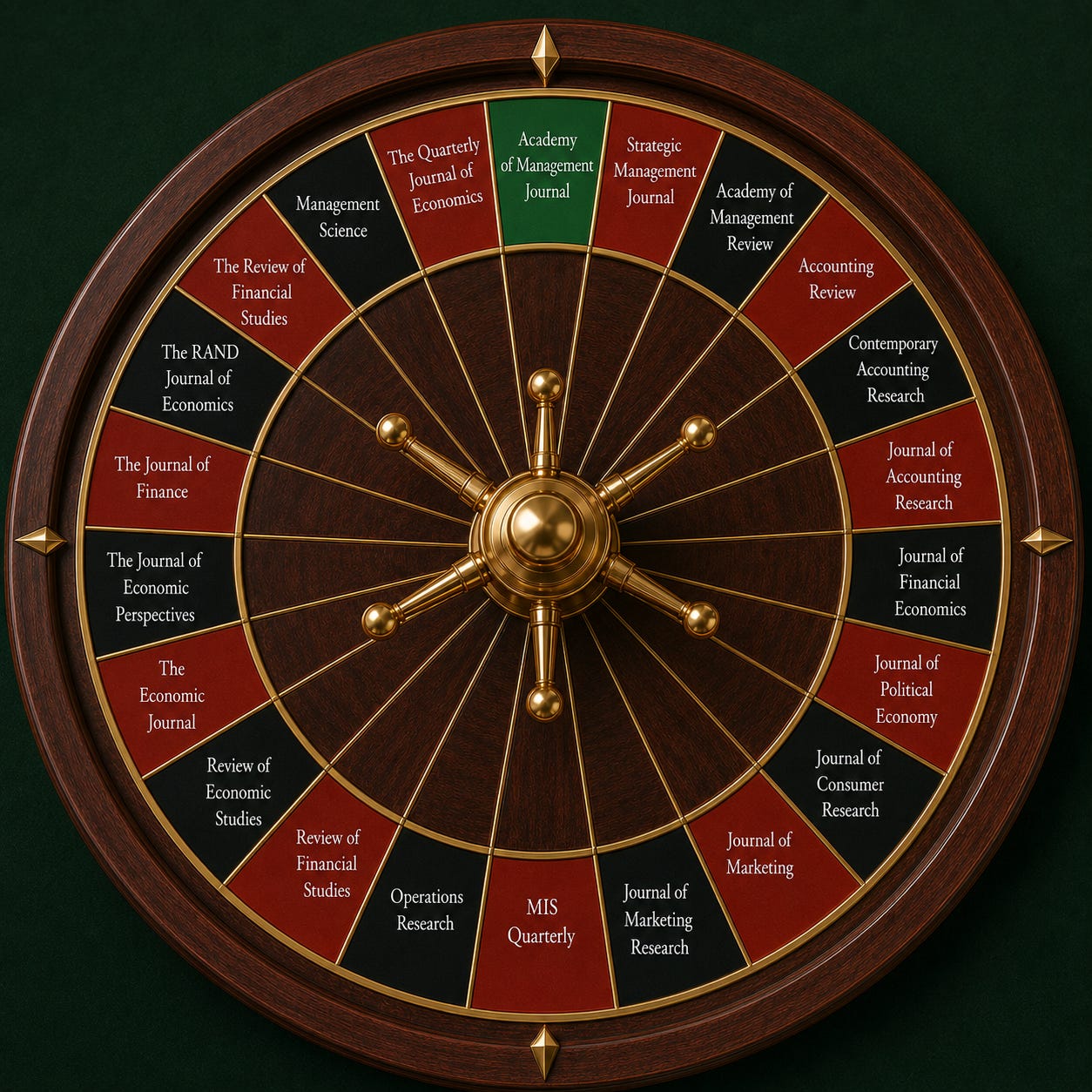
In our last post we discussed how the publication incentives provided by universities are heavily influencing the AI-driven push toward more rather than better, but these problems certainly pre-date ChatGPT. A key component of these incentives is the journal lists and rankings that categorize them in different quality tiers (or “tranches” as the cool kids say). UT Dallas has their list, as does University of Georgia/Texas A&M (TAMUGA).2 ABS has their own ratings from 1-4*. And perhaps most (in)famously, The Financial Times has the FT50 list, which was just recently updated and then nearly instantly retracted to the FT49.
There are always disputes about list inclusions/exclusions, whether it be Sam Fender on a Spotify song list or Journal of Business Ethics (or many others) on FT49. And then there will complete agreement about others, including Jeff Buckley or maybe ASQ (where I just got rejected again).3 Oh wait. . . here’s the right link. When a journal list changes, however, it can have real consequences for careers, even if the change might be justified. Because schools are just silly enough to deny tenure to someone because the journal they published in got voted off the island. Would I have sent two papers to JBE as an untenured professor were it not on the FT50? Well, probably, since I (unwisely) sent one of my best papers ever to the Berkeley Electronic Journal where it has racked up 30 GS cites in 14 years. But I also had the luxury of being at a school where the FT50 meant nothing for my promotion case. Had the career incentives been different, I’m sure I would have responded accordingly.
The FT49 changes
The Financial Times updated their list based on mysterious input from various Dean offices—perhaps the same brilliant process that ranked my employer at 167 in the QS Global Rankings despite our 26 Nobel Laureates and over $1 billion in annual research spending. See? Even I can complain about lists that don’t give me the results I like. There were really only three swaps in the FT49 this year. Journal of Business Ethics, Organization Studies, and Human Relations were kicked off. American Sociological Review, Psych Science, and Academy of Management Annals were added. Some people are happy, and some people are mad. This is the nature of lists with limited capacity. If we have to have lists (we don’t), then some adjustments are generally good, but the real question is whether it’s the right change. I don’t have any skin in this game. My net FT49 count change was zero, subtracting JBE (2) and adding Psych Science (2).
It’s hard for me to argue with adding ASR. Sociology is an important foundation in business research, so the notion that neither of the top two journals are on the list was always strange. I also can’t argue with adding Psych Science. What I can’t speak to is why ASR and PS instead of AJS and JPSP (or others). I’ll let my senior editors answer that one. Annals? There are argument for or against. It really depends on how you view review papers (integrative or not). But if three get added, then three have to get dropped (ignoring the Sloan day-after exit), and if I were forced to pick three I am certainly I wouldn’t have picked that that combination.
The removal of JBE has caused a bit of an uproar on social media, and I’m sympathetic to the real loss it means to many scholars. It definitely seems smart to have a business ethics journal on the list, and my revealed preference of submitting there in the past is clear. But I wonder if JBE’s removal was partly based on its massive publication volume. In 2019, JBE published at least 451 full papers (as defined by Web of Science): way more papers than were published in ASQ, OS, AMR, ASQ, and AMJ combined. This certainly can’t touch the 11,794 papers in the journal Sustainability last year, but it’s a lot of papers. So even with JBE down in the 300 range last year, that kind of size creates a huge imbalance on a list, although that certainly hasn’t stopped the S&P 500 from being dominated by less than a dozen companies. Was that a factor? I don’t know. The high volume there goes back at least 15 years. But I do know that there are some great papers in JBE and I hope they will continue to be appreciated by promotion committees for the value they represent.
New Senior Editors!
We’re excited to have a new group of senior editors joining Organization Science over the coming months. I typically do this continuously, but I’m so overloaded that I onboarded folks in batch mode.4 It’s a great mix of scholars across macro, meso, and micro, with a mix of methods and topics. Although I am always asking where we need more editorial support, I don’t specifically to match close replacements with departing editors. Primarily I’m looking for great scholars who are pushing forward new ideas and who fundamentally care about research quality over metrics. And who care about people. The new editors will be showing up online and in the system as their start date approaches. I’m grateful for their willingness to join our scientific pirate exploration ship.
Justin Frake (University of Michigan)
Cédric Guttierez (Bocconi University)
Jean-François Harvey (HEC Montreal)
Timothy Kundro (University of North Carolina)
Ming Leung (UC Irvine)
Jessica Huisi Li (University of Washington)
Kate Odziemkowska (University of Toronto)
Andrea Prencipe (Luiss University (Rome))
Vera Rocha (Copenhagen Business School)
Rachel Ruttan (University of Toronto)
Trevor Young-Hyman (University of Pittsburgh)
Editors Who Have Recently Stepped Down
We’ve had a number of senior editors end their terms since the new year after years of contributions to the journal. They are the ones that make the journal succeed because in handling papers so carefully and responsibly, they’ve allowed me to stay out of the way. This is good for everyone, but most importantly for the journal. I particularly want to thank the majority here who stayed on when I took over this role and continued through the journal limit of two terms (six years). I’m grateful for your trust, and excited to see what you do next (besides sleep more). Collectively, these editors handled 51 of our publications, or three complete issues. Other great editors stepped down in prior years as well.
Samina Karim (Deputy Editor:1,335; Senior Editor: 113)
Jay Anand (Senior Editor: 151)
Vanessa Burbano (Senior Editor: 22)
Jason Davis (Senior Editor: 32)
Daniel Feiler (Senior Editor: 63)
John Joseph (Senior Editor: 159)
Marissa King (Senior Editor: 68)
Mae McDonnell (Senior Editor: 132)
Metin Sengul (Senior Editor: 138)
David Tan (Senior Editor: 109)
Well, I’m pretty sure it was more eloquent when the person said it.
I was wondering on the plane if there was a huge debate on whether to call it TAMUGA or UGATAM. It’s a tough choice. TAMUGA makes me think of the horn sound on old pickup trucks, while UGATAM reminds me of the one of the great Swedish contributions to world culture. They could have just rearranged the letters to spell “GAUTAM” and then given Org Science quadruple points, right?
According to the PhD Job Spreadsheet, the repository of all truth (except when they criticize me), ASQ is the only journal with 100% agreement on “A” status. Org Science came in at 99% (thanks MIT).
Cue the nightmares of Toyota executives repeating “too much inventory” as they pointed to my kanban cart at Boeing.