
New Papers, The Winter Conference Call, and Reviewer Awards
. . . and a terrible stats joke (are there any that aren't terrible?)


It’s week two of the public school year here in St. Louis and already a viral plague has swept through the middle school and taken down innocent bystanders (like me) in its wake. Pseudoephedrine is remarkably good, however, so we’re pushing forward. A number of you have asked about our chief editorial cat, but he’s been too busy battling his tail to be of much help to the journal recently (see evidence at the bottom of this post). This seems a bit too much like a metaphor for my new role as strategy group chair here at Olin.
Below, we have a bunch of new articles-in-advance on our website that I’m excited about, including four solo-authored papers by junior faculty, which is great to see in an era with escalating author numbers. We have electric cars, cookstoves, Bitcoin, a lot of CEOs, and the increasingly important topic of free speech and censorship.
We’re now posting the formal call for the Organization Science Winter Conference February 23-25, 2026 in Paris, France, and I have some reviewer award winner announcements for both 2024 and 2025. I announced the the 2024 awards at AOM that year, but failed to deliver on certificates and more public announcements. I blame this entirely on. . . well, me. Finally, we have formal announcements now for our workshops in Hong Kong and Beijing in December, which is probably less relevant to you because Substack is blocked in mainland China. It’s a lot of content, so let me get out of the way and give you some value. For the three two of you hoping for rambling EIC thoughts, sorry to disappoint you.
New Papers:
The Effects of Competition and Scarcity on Interpersonal Communication in Organizations
Kariyushi Rao
Past observational studies suggest that communication declines when an organization is exposed to an adverse environmental event. To understand why this might happen, the author examines the effects of competition and scarcity on information sharing and seeking in interactive groups of experimental participants. Groups exchange less information when exposed to competition (a bonus based on relative performance). However, exposure to scarcity (negative demand shifts) has no effect on information exchange. These findings advance our understanding of the relationship between competition, scarcity, and interpersonal communication in organizations. They also have important implications for the design of incentive schemes in modern firms.
Diana Jue-Rajasingh
Can non-firm knowledge intermediaries help new industries emerge in countries they don’t operate in – and if so, how? This article studies how a non-firm first-order knowledge intermediary (FOKI), the Global Alliance for Clean Cookstoves, helped create markets for clean cookstoves, a technology aimed at improving health and environmental outcomes among low-income users in developing countries. Even though this organization only operated in a few countries, it indirectly supported entrepreneurial entry in many others through “second-order knowledge intermediaries” (SOKIs). SOKIs acquired industry-building knowledge and capabilities from engaging with the FOKI and transferred this industry-building knowledge and capabilities to new places, helping to support local entrepreneurial entry and extend the FOKI’s impact.
Policymaker Responses to CEO Activism
Christopher Poliquin, Young Hou
Can CEOs change the opinions of elected officials by publicly voicing support for a non-business political cause, such as police reform? And will elected officials punish CEOs for voicing controversial political opinions? Many CEOs and businesses speak out on controversial political issues like abortion, gun control, and police reform with the hope of affecting policy. We presented hundreds of local elected officials with a CEO statement supporting police reform to see if it would change their views. It didn’t. Moreover, we asked officials about their willingness to engage with politically active CEOs and found they’re less willing to meet with or help a CEO’s company relocate to their area if the CEO has taken unpopular political stances.
Jino Lu
Prior research on demand-pull innovation has found that increased downstream market demand for a technology generally drives innovation within that technology. This study shows that the same demand can sometimes adversely affect inventive activities among firms in other technological domains through competing away skilled knowledge workers. Empirically, the author exploits an environmental policy shock, which led to an exogenous increase in demand for electric vehicle (EV) technologies. Following the policy, there were increased EV inventive activities by EV firms. However, firms in adjacent (non-EV) domains produced fewer inventions because they became more likely to lose knowledge workers to EV firms. Notably, affected firms in growing technological domains, and smaller, younger firms were more adversely (or at least equally) impacted.
J. Daniel Zyung
Why are some CEOs fired after violating stakeholder rights while others survive? This paper examines how boards decide whether to dismiss CEOs when companies harm their customers, employees, or the environment. A key finding: CEOs’ fundamental motives—whether assertive and results-driven (agentic) or caring and relationship-focused (communal), as reflected in their language—shape how boards interpret these violations. CEOs who project strong stakeholder commitment through communal language face greater dismissal risk when their firms fall short, while those who emphasize competitiveness and performance through agentic language are often shielded from blame for the very same failures. These effects become even stronger when other signals, like CSR efforts and media sentiment, reinforce the expectations. Ultimately, boards respond not just to outcomes, but to whether CEOs’ actions violate the image they’ve cultivated.
Brittany C. Solomon, Alexandra K. Scott, Matthew E. K. Hall
This paper reveals how workplace free speech policies shape employee psychological safety in today’s polarized climate. Drawing on a nationally representative U.S. sample, the authors uncover a striking partisan divide: Democrats are more troubled by coworkers’ prejudiced social media posts, while Republicans are more concerned about employer censorship. Across five studies, the research demonstrates that organizational censorship of prejudiced speech boosts psychological safety for Democrats but can diminish it for Republicans. However, when censorship aligns with organizational values—especially targeting anti-Black or threatening speech—psychological safety can be fostered for all. As polarization grows, these findings offer organizations actionable insights for balancing free expression and inclusivity, helping to strengthen the social fabric and psychological safety of the modern workplace.
Courting the Sharks: The Influence of CEO Narcissistic Admiration and Rivalry on New Venture Funding
Paul Sanchez-Ruiz, Andrew Blake, Oleg Petrenko, Ileana Maldonado-Bautista, Veroniek Collewaert, Kendall W. Artz
How do different behavioral types of CEO narcissism—admiration versus rivalry—influence investor sentiment and funding success? The study shows that CEOs high in narcissistic admiration attract positive investor sentiment and are more likely to secure funding. In contrast, those high in narcissistic rivalry generate negative investor sentiment, reducing their chances of receiving investment. Investor sentiment acts as a key psychological mechanism linking CEO personality to funding outcomes. Even small differences in a CEO’s narcissistic expression—whether charming or combative—can significantly shape investor emotions and financial decisions. CEOs high in admiration raised approximately $10,000 more in funding on average, while rivalry-oriented CEOs experienced a measurable funding penalty.
Andrew Isaak, Baris Istipliler, Suleika Bort, Michael Woywode
How do country-level regulation and corruption impact the development of Bitcoin trading and Bitcoin platform founding through the lens of Decentralized Autonomous Organizations? Our study found that when a country makes Bitcoin legal, more people start business exchanges related to it—like creating websites where people can trade Bitcoin; That’s because making it legal removes a lot of the uncertainty and risk for business founders. But interestingly, we also discovered that when a country bans Bitcoin, it doesn’t always stop people from using it. In fact, it can have the opposite effect—more people start trading Bitcoin anyway. This is called the “forbidden fruit” effect, where banning something makes it more tempting, which happens especially in countries with a lot of corruption at the top levels of government, because many people in those places don’t trust regular banks or politicians.
We also found that corruption plays an important role in the world of Bitcoin. In particular, high-level corruption can actually make it harder for people to start Bitcoin businesses, even if it’s legal. But lower-level corruption can sometimes help entrepreneurs work around the problems caused by high-level corruption.
2026 Organization Science Winter Conference:
The details are now set for this year’s conference, which I’d previously announced as being held at the wonderful ESCP Business School location in Montparnasse, Paris on February 23 - 25.

Ruthanne Huising has been leading the planning, and the focus of this year is “Studying Work, Doing Work: The Purpose and Practice of Organization Science.” The call, posted below, lays out a number of topics that might be included in the conference, but it is certainly not exhaustive. It’s certainly apropos here in the States, where it’s Labor Day Weekend. One of the nice things about a small conference where we try to have 50% new folks each year is that we worry less about topics including everyone, even if we make them very broad. So if you were hoping for a theme of “Interstellar Blockchain Ecosystems” you can always hope for that next year. Ruthanne is organizing things a bit differently this year in having a larger committee that includes more junior folks. So thank you to our committee of Nicole Abi-Esber, Michaël Bikard, Jillian Chown, Gina Dokko, Lindy Greer, Audrey Holm, Chang-Wa Huynh, Jacqueline Ng Lane, Pedro Monteiro, Samantha Ortiz Casillas, and Bukky Akinsanmi Oyedeji. I’m very excited to not be doing heavy lifting this year.

Award-Winning Reviewers:
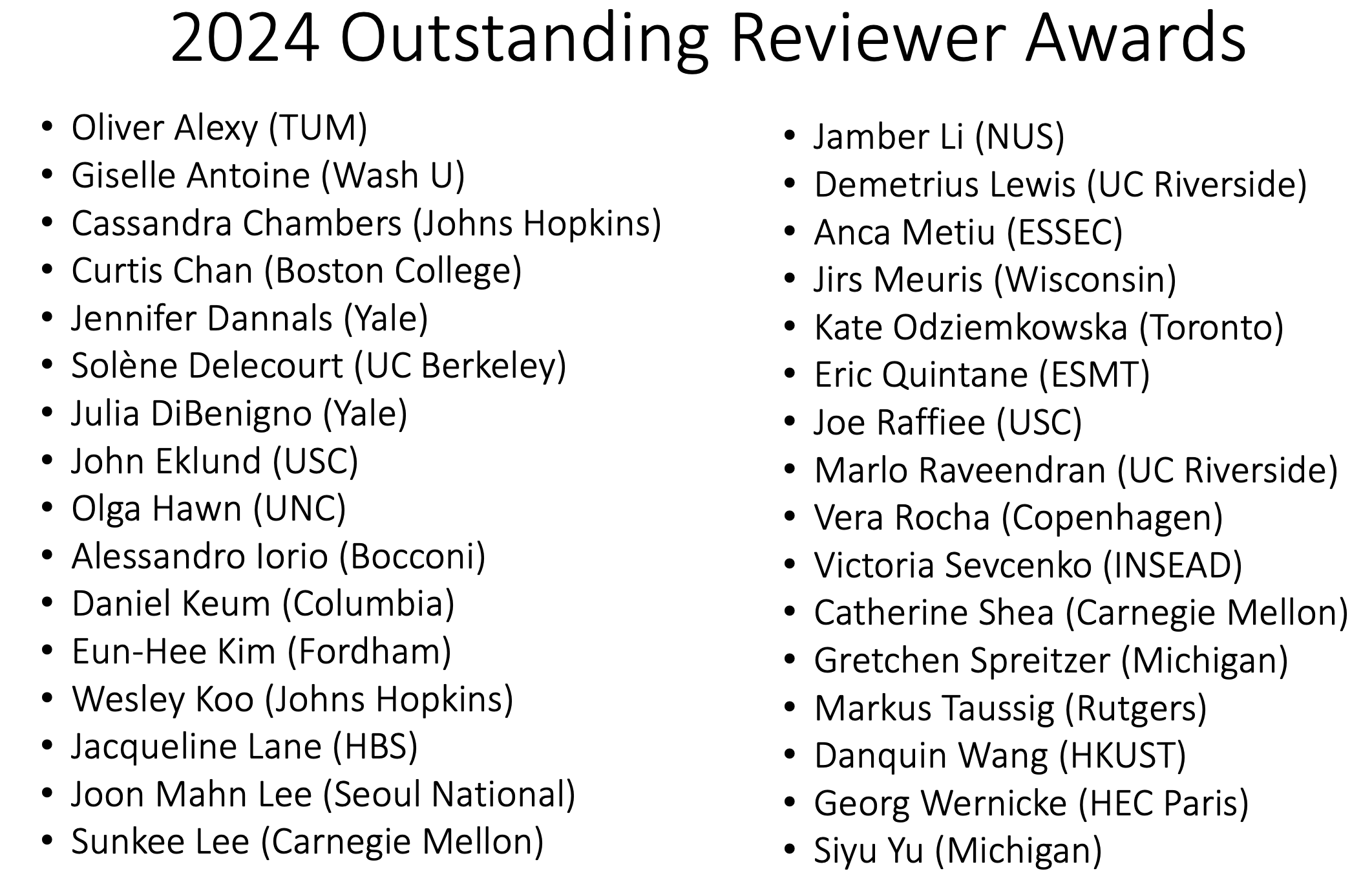
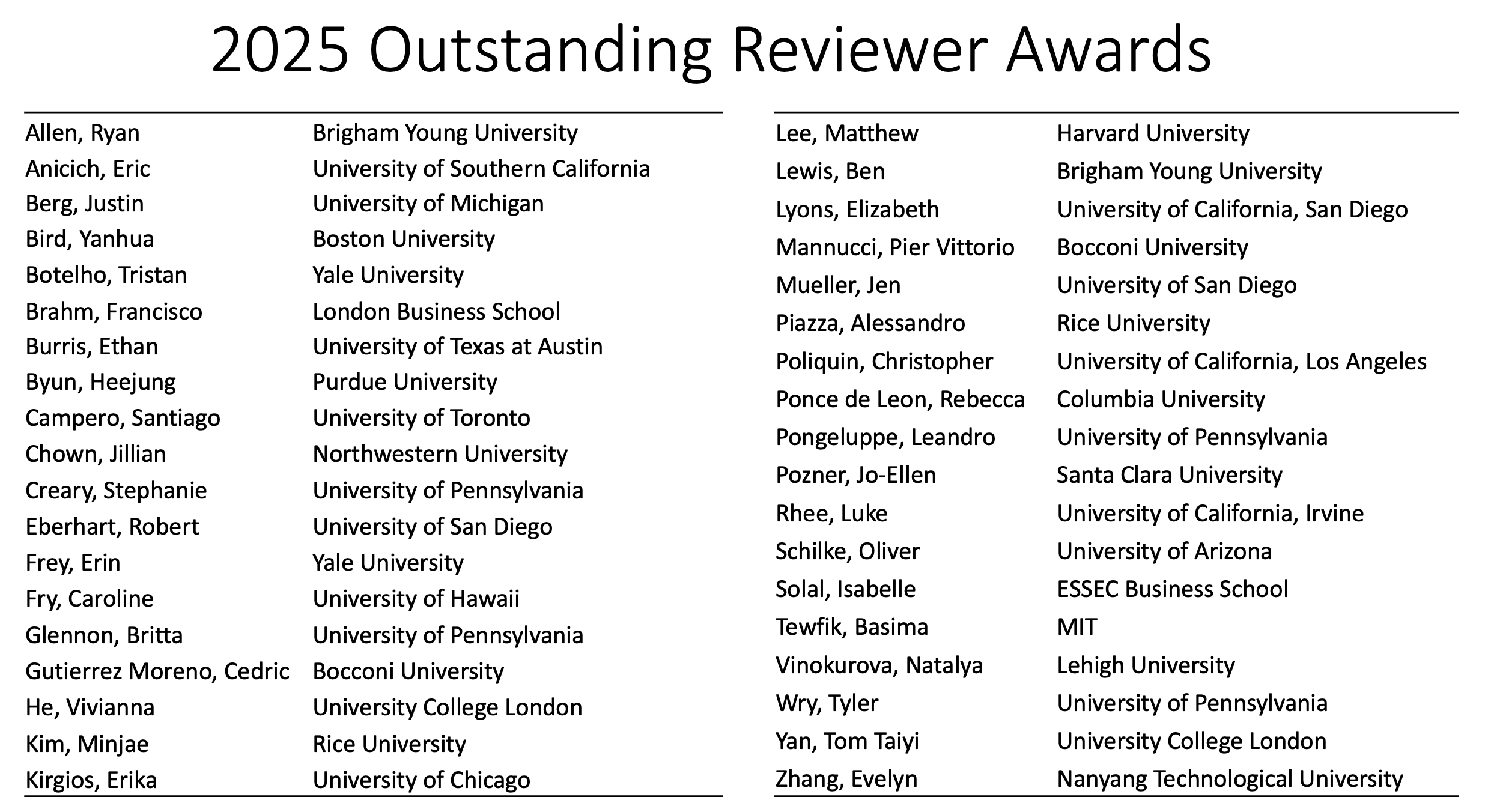
I’m also very happy to announce our awards for best reviewers in both 2024 and 2025. These folks did an outstanding job both in the quality of their many reviews and their willingness to complete them in a reasonable amount of time. These winners represent less than 3% of all reviewers we invited. We’re grateful to them and all the reviewers who make up our ERB and broader review pool. You’re a huge force behind the success of the journal. We don’t give these to folks who have won in the previous two years, which is why you don’t see Kunyuan Qiao up here twice (he won in 2023) despite his chart topping performance. And yes, I know my formatting is inconsistent below, but it’s late Friday afternoon and I feel like my head is about to explode. Affiliations represent institution in year of award.
That’s all for this week. I will now head home for my typical Friday night activity of rummaging through the freezer desperately hoping to find a strawberry mochi ball my son might have missed. And just for fun, here’s Butterburger training to battle counter-normative papers reporting one-tailed tests.
Have a wonderful weekend.
- Lamar