
Dissertation Finals, The Winter Conference, and New Papers Everywhere
What does an editors-in-chief meeting look like, anyway?


Last night I returned from Atlanta to Org Science Headquarters only to find Chief Editorial Cat Butterburger recovering from what was evidently an epic battle on our front deck. My best guess is that a neighboring cat screamed “two people don’t make a team” at him followed by “you can’t use OLS for binary outcomes.”1 There’s no way he could have stepped back from those fightin’ words. Anyway, he’s recovering and in hiding while we investigate our suspicion that this was a hostile takeover attempt by a for-profit publisher such as Wiley. . . because don’t all journals have their own cats?

Let me get to the substance of the post so you can all move on with your day. We have the dissertation finals results, a reminder on the winter conference and special issue, and four new papers. I’m off to the airport again in the morning, so enjoy the rest of your week!
-Lamar
Org Science Dissertation Finals
The Atlanta trip marked the finals of the 2025 Organization Science Dissertation Proposal as part of the broader INFORMS conference. Michael Park of INSEAD did a wonderful job organizing it, with help from Rebecca Ponce de Leon, Basima Tewfik, and Ronnie Lee. Thank you to all of you who were willing to review all the initial submissions. It was a great set of finalists who seemed unsurprisingly happy to be back out in the sun after a day of presentations.
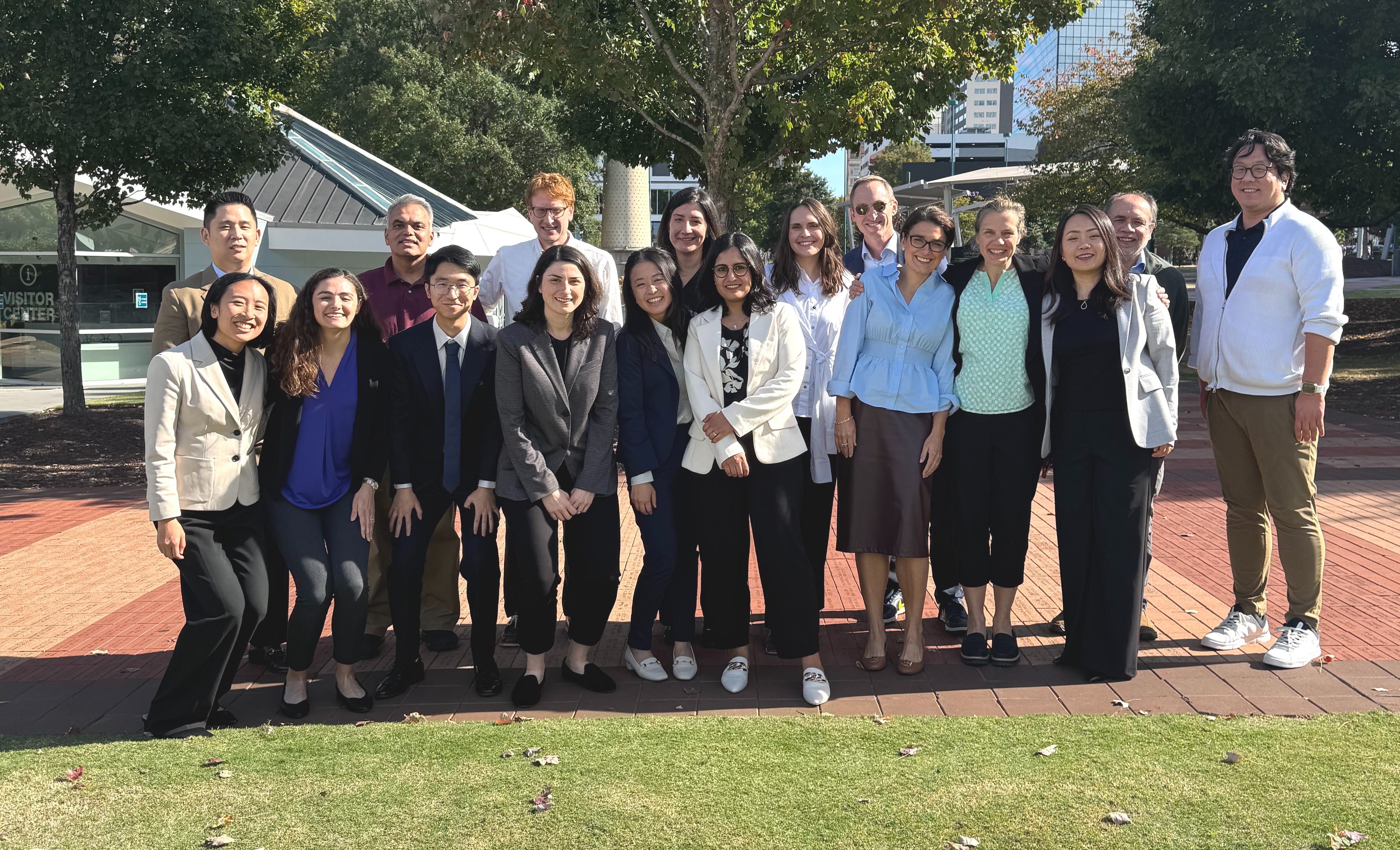
This year’s winner was Clem Aeppli, a doctoral candidate in sociology at Harvard University studying wage inequality across firms. It was such a strong finalist group that we had two runners up: Hongyuan Xia (Cornell Economics) and Wajeeha Ahmad (Stanford MS&E). The other finalists were Victoria Zhang (MIT), Ilana Brody (UCLA), Jessica Reif (Duke), Laura Lam (Toronto), and Meenal Banga (UT Austin). What great hires they all would make!
We also had our annual INFORMS meeting of the editors-in-chief of the seventeen journals, which you might imagine resembles some council of the kingdoms from a fantasy novel, complete with flagons of ale, legs of mutton, spies, and flags in blue, green, and red, debating the growing threat of AI hordes in the West. Alas, there was no such excitement, but instead some debates on whether reviewer conflict-of-interest was a relevant issue when math was involved. . . and some really nice chocolate-raspberry tortes!
Winter is Coming!
It’s getting colder, so grab your jasmine tea and enter your submission for the 2026 Org Science Winter Conference in Paris on February 23-25. They’re due November 1. If you’re interested in coming and have something to present, please do submit. It’s a great event and. . . well. . . it’s in Paris. And as always, attendance is limited to those who will bring me lots of macarons be presenting. The theme is Studying Work, Doing Work.2 There’s a doctoral consortium as well for those of you who qualify. In fact. . . it might be worth going back to grad school just to attend. Ruthanne and the gang have something awesome in the works, so I’ll look forward to seeing many of you there.
Special Issue Submissions Open Soon!
The special issue on Organizations in the Global South will be open for submissions starting November 1. The submission window goes through April, so you have plenty of time, but for those of you sitting around with a relevant paper that’s ready to go, submit away. We’ll be processing in real time, so submitting earlier just means earlier decisions.
Recently Published Papers
We also have some recently accepted papers that emerged in our articles-in-advance. Our authors, editors, and reviewers continue to produce great research while I mostly try to stay out of the way. This set includes a fascinating set of experiments from Kenya, innovation in medical devices, empathy and entrepreneurship, and managing future selves. We’re a little behind on the recently published papers but will catch up shortly.
Situational Support for Corruption: A Two-Part Field Experiment on Collusive vs. Extortive Bribery
Christopher Yenkey, Brent Simpson, Paul Bliese
Everyone knows that bribery entails a private-public tradeoff. Most say they reject this tradeoff, yet bribery remains pervasive. Anti-corruption campaigns aspire to convert tolerance for the private-public tradeoff into intolerance through the use of negative externality messages that remind would-be bribe payers of the harm done to others. To the contrary, the authors find more of a “preaching to the choir” effect, where negative externality messages are more effective in reminding those who already reject bribery’s private-public tradeoff of their existing beliefs than they are in converting those who prioritize their private goods. A novel two-part field experiment design is used to capture both pre-existing beliefs and actions of a random sample of 1,403 residents of Nairobi, Kenya.
Seojin Kim , Rajshree Agarwal , Brent Goldfarb
How do prior histories of organizations affect their investments in incubating radical technological systems for value creation in bionic prosthetics? And, how do organizations’ prior histories and technological investments impact their subsequent value capture strategies? We find that all organizations (mechanical prosthetic incumbents, established firms in other industries and startup) contribute to the creation of radical technology and its component subtechnologies. Although incumbent firms make up less than 20 percent of all investing firms, they played a role as integrators, thus they pioneered and dominated product commercialization. Startups capture value through alliances or by being acquired, while established firms in other industries leverage their knowledge in adjacent value chains rather than entering the nascent industry.
Dana Kanze
Does investors’ former entrepreneurial experience cause fundraising entrepreneurs to perceive them as empathetic, improving how they evaluate these investors? Venture funding tends to be a lonely setting in which entrepreneurs struggle to develop long-term relationships with investors under conditions marked by high uncertainty and information asymmetry. We need to better understand what levers can help entrepreneurs sense potential for shared understanding and emotional support to improve their evaluation of investor ties. Through this set of studies, I found that a type of experience alignment—achieved when both investors and entrepreneurs possess entrepreneurial experience—serves as a powerful lever to help these parties see both sides. Entrepreneurs were more likely to perceive investors with entrepreneurial experience as being empathetic than investors without this experience. In turn, entrepreneurs rated investors whom they perceived to be empathetic more favorably than those they did not perceive to be empathetic.
Karoline Strauss, Julija N. Mell, Frederik Anseel, Annemijn Loermans, David Sluss
How can people better navigate the many possibilities they imagine for their future career, especially when those possibilities seem diverse or even conflicting? We explored how the way people envision themselves in the future – not just what they imagine, but how the pieces fit together – affects their motivation and behavior. People who are able to find synergies between the different elements the vision for their future self contains feel more energized and are more likely to be proactive in managing their career. We call this “future self complementarity,” and we show it plays a powerful role in how people shape their professional futures. The groundbreaking insight is that a clear vision of the future alone is not enough: it’s the connections between different elements of our imagined future self that generate energy and drive proactive career behaviors, such as developing new skills or networking. Quantitatively, we found that even after controlling for how clear someone’s future vision is, the degree of complementarity predicted increased proactive career behavior.
I always consider two people to be a team if they are engaged in joint production, but evidently I’m in the minority. I do, however, attest to linear probability models, which work great so long as they produce predicted values between 0 and 1.
Which I should have been doing on the flight home last night instead of reading old emails.